
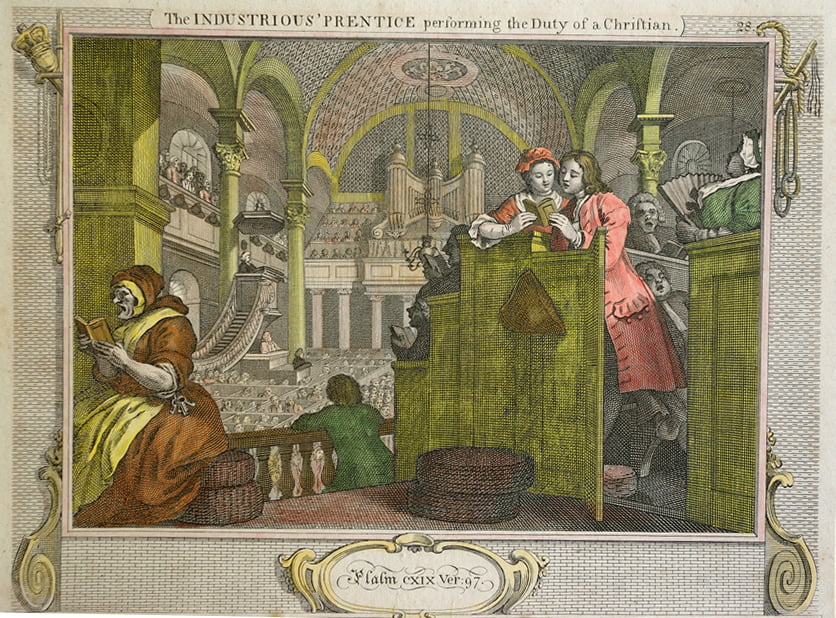
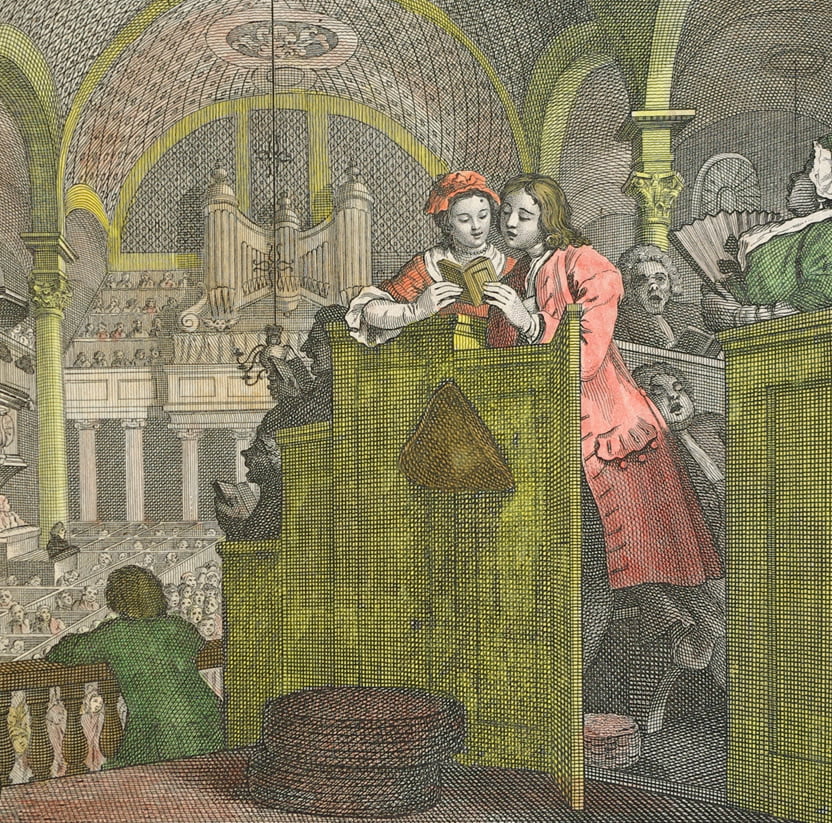
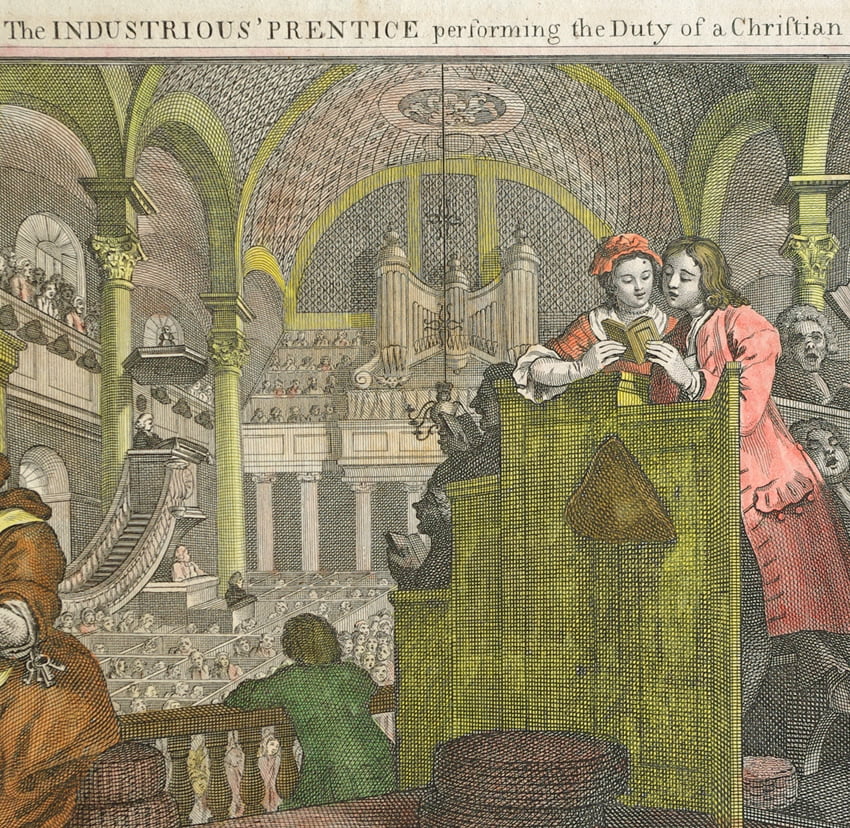
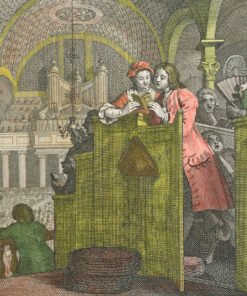
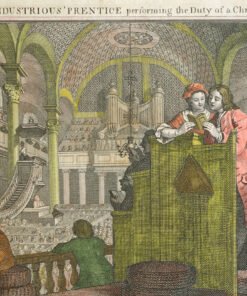
“Industry and Idleness” stories the careers of two City apprentices (Francis Goodchild and Tom Idle), a moral journey by Hogarth “calculated for the use & Instruction of Youth”. The ‘good’ apprentice is Francis Goodchild, and ‘bad’ apprentice, Tom Idle. The apprentices’ physical appearance contrast as the series advances between serene, polite, elegant and gentlemanly, while Idle’s features become increasingly contorted and grotesque, and his posture slovenly and misshapen. Their respective environments also diverge from initial parity in the same work space. Goodchild is separated from the street and its unruly occupants, whilst Idle is untidy and undisciplined. The conclusion is Goodchild’s triumphal procession as Lord Mayor, and Idle being executed. This is Plate 2 “The Industrious ‘Prentice performing the Duty of a Christian”, and contrasts with Plate 3 “The Idle’ prentice at Play in the Church Yard, during Divine Service.” Here we see Francis Goodchild at church with the master’s daughter. An earlier edition print by Ernst Ludwig Riepenhausen (1765-1840) c. 1820 signed bottom right. Line engraving on paper, laid down. Unframed, coloured. Riepenhausen was well respected for his engravings after Hogarth, often preferred to those by Hogarth himself. William Hogarth (1697-1764) was an English painter, printmaker, social critic and cartoonist. The overall size is ca. 28.7 x 21.5 cm. The image size is ca. 26.2 x 20 cm.
Related products
Selection of Antique Pictures, including Maps, and other Antiques
Selection of Antique Pictures, including Maps, and other Antiques
Selection of Antique Pictures, including Maps, and other Antiques
Selection of Antique Pictures, including Maps, and other Antiques
Selection of Antique Pictures, including Maps, and other Antiques
Selection of Antique Pictures, including Maps, and other Antiques
Selection of Antique Pictures, including Maps, and other Antiques
Selection of Antique Pictures, including Maps, and other Antiques